


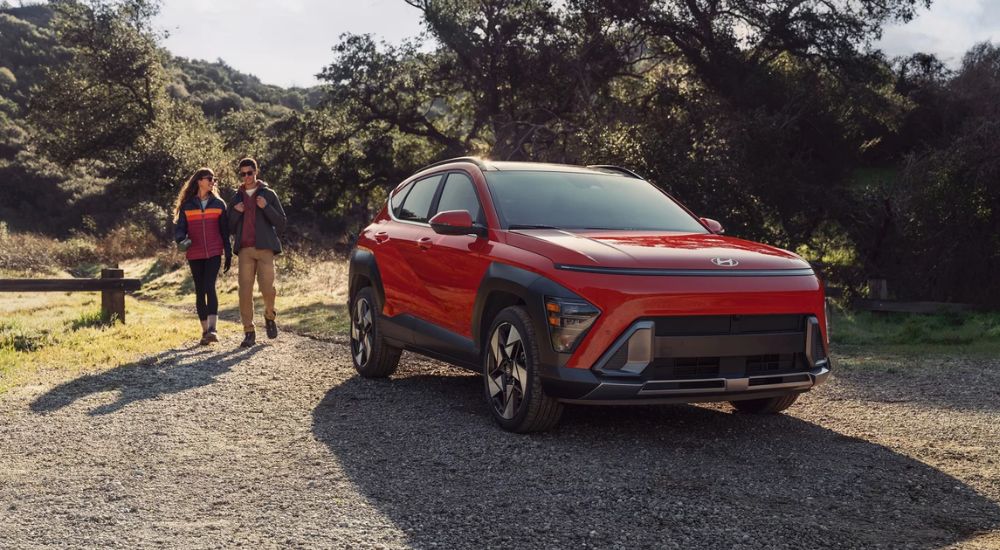
Your time behind the wheel is what you make of it. If you’re looking for a nondescript ride that’ll get you from home to work and back again, there are plenty of serviceable crossover models designed to accomplish just that. They might not provide much in the way of thrills, and you might have a tough time picking your vehicle out of a crowded parking lot, but they’ll get the job done. However, if you’re looking for a bolder take on the crossover formula, and one that’s sure to turn some heads as you go about your daily routine, it’s time to find a Hyundai Kona for sale near Grayslake. The SUV might be classified as a subcompact, but it’s big on style and not afraid to take some chances.
Boasting one of the most powerful engines in its class, and dressed to impress with a bold exterior and feature-rich cabin, the Kona proves that some brands still have their finger on the pulse, while others are content to create an underwhelming slate of copycat crossovers. Let’s see how the 2026 Kona compares to Honda’s own subcompact, the HR-V, as we explore the SUV that’s turning the segment on its head.
Never Short on Style
The Kona’s most obvious selling point is probably the SUV’s eye-catching style. There’s been a subtle shift in the world of automotive aesthetics in recent years as a wave of all-electric models pushes the industry in a bold new direction. The Kona retains the traditional gas-powered engine but draws plenty of inspiration from its EV competitors, with a cutting-edge design that’s decidedly futuristic.
Just take the crossover’s signature LED light bar, which Hyundai has dubbed the Seamless Horizon Lamp. While these types of full-width light bars are usually reserved for newer EV models, Hyundai sets the Kona apart from much of the crossover pack with this modern upgrade. The SUV sports a similar light bar at the rear and also adopts a more minimal approach to the front grille, with a smooth, sculpted look that’ll be familiar to any fans of Hyundai’s IONIQ EV crossovers.
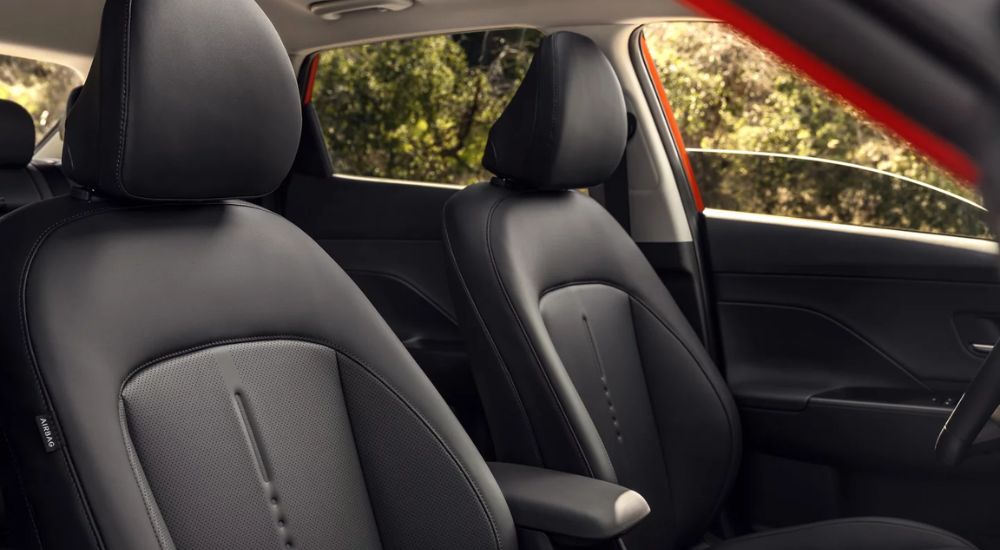
From the sharp creases that flow across the SUV’s sides to its sculpted fenders, geometric design, and the floating roof effect made possible by the Kona’s available black pillars, Hyundai’s subcompact is never short on style. Throw in a sophisticated ambient lighting system that’ll automatically adjust based on the current drive mode, plenty of soft-touch padded surfaces, H-Tex synthetic leather, and other premium materials, and it’s easy to see how the Kona has become such a trendsetter in the subcompact segment.
The HR-V represents a very different take on the crossover approach, at least from a design perspective. Honda has played it safe with its subcompact model, which, while not an eyesore, lacks much of the Kona’s cutting-edge appeal. It’ll come as little surprise to learn that the HR-V borrows heavily from the Civic sedan, especially when you get a look at the interior. The SUV’s dashboard is almost identical to the Civic’s, with its honeycomb vent design. The HR-V feels a bit old-fashioned, relying on physical controls rather than digital interfaces. The HR-V’s timeless aesthetic is sure to satisfy those looking for something familiar, but it could prove a bit underwhelming for young drivers seeking a ride that reflects their contemporary style. The Kona offers an impressively modern alternative that’s designed to help buyers in Grayslake stand out against the sea of crossover models.
Small in Size, Big on Space
It’s hard to overstate the importance of flexibility when comparing crossover models. One day, you might be in the market for a spacious option that can comfortably accommodate five adults. The next could see you desperate for cargo capacity as you prepare for a longer road trip or off-the-grid adventure. The Hyundai Kona offers the sort of flexibility few subcompact models can match, and places right towards the top of the segment in terms of both cargo and passenger space. With 63.7 cu.ft. of maximum cargo space, the 2026 Kona earns a top-three finish in the subcompact segment. The Honda HR-V struggles to keep pace and could prove frustrating for those who rely on their SUV’s cargo-hauling potential, with just 55.1 cu.ft. of cargo space.
The Kona’s generous dimensions are sure to prove useful on moving day or when you’re trying to lug a bulky new purchase back home, but it can also offer plenty of storage when all five seats are occupied. The rear cargo area measures 25.5 cu.ft., giving the Hyundai a one cu.ft. advantage over its Honda rival. It might not be a huge gap, but it could mean the difference between packing your go-to adventure gear and having to make some tough pre-travel decisions. The Kona also edges out the HR-V in terms of passenger space, with 126.7 cu.ft. of total volume to the Honda’s 123.1 cu.ft. Again, it’s not a massive difference, but it can have a noticeable impact when you’re trying to comfortably seat adult passengers.
Subcompact models aren’t generally renowned for their spaciousness, and often require full-grown riders to perform some circus-level contortions to fit in the back seat. The Kona trends towards the larger end of the segment and easily bests the HR-V in front-row head, shoulder, and hip room. The difference between the two models is even more noticeable when you slide into the second row, with the Kona offering both more headroom and legroom.
Prioritizing Power
Hyundai and Honda made two very different decisions when it comes to performance. The HR-V is more in line with what Grayslake drivers have come to expect from a subcompact crossover, which is to say, not much. The SUV’s lone engine is a 2.0L I-4, limited to a paltry 158 hp due to the lack of a turbocharger. To be fair, that’s not too far off the segment average, with most entry-level engines providing around 150 hp, but it can also make the HR-V a bit underwhelming when you’re behind the wheel. The SUV’s 9.4-second zero-to-60-mph time is a bit glacial, and could lead to some real frustration when trying to overtake another vehicle on the highway.
The 2026 Kona kicks things off with its own naturally aspirated 2.0L I-4. Although it’s slightly less powerful than the base HR-V at 147 hp, it still manages to shave a good 0.2 seconds off the Honda’s sprint time. More importantly, it’s significantly more efficient with the base engine achieving an EPA-estimated 31 MPG combined. The HR-V is relatively thirsty at 28 MPG combined, which would be excusable if it weren’t also slower.
That said, the Kona’s real advantage lies in its optional 1.6L turbocharged engine. Tiny as it may be, the I-4 engine is a bona fide powerhouse with the ability to churn out as much as 190 hp. That’s enough power to accelerate from 0 to 60 mph in 7.5 seconds, which should instill plenty of confidence when it’s time to put the pedal to the metal.
The Kona’s 1.6L mill isn’t quite as efficient as the base engine at 28 MPG combined, but this is a bit of a good news/bad news situation. Sure, the souped-up SUV might cost you a little more at the pump, but it’s because the upgraded engine routes its power through a traditional eight-speed automatic instead of the continuously variable transmission (CVT) found on the base model. The automatic provides a more traditional driving experience and offers the sort of tactile feedback that can go a long way toward creating a stronger connection between driver and vehicle. Meanwhile, HR-V owners will be stuck with a CVT that, while efficient, can be a bit dull and create a pesky drone.
A Technological Achievement
The Hyundai Kona and Honda HR-V may be pretty evenly matched in a few key areas, but the two subcompact SUVs offer a very different experience when it comes to standard infotainment and safety tech. This might not be a dealbreaker for every driver, but it’s an important factor to consider if you’re a tech-savvy driver who expects your vehicles to keep pace with your digitally dependent lifestyle.
The Kona’s floating dashboard serves as the crossover’s cockpit, putting a 12.3-inch infotainment display within easy reach of both the driver and front seat passenger. The crossover comes standard with a 4.3-inch digital gauge display, but moving up to the top half of the trim ladder swaps it for a 12.3-inch display that perfectly complements the expansive infotainment system. Honda’s subcompact struggles to compete, with a 9.0-inch infotainment display that’s starting to look a little dated in the year 2026. The HR-V does offer a standard 7.0-inch digital gauge cluster across all trims, but lacks the upgrade potential of the Kona.
Both models include wireless Apple CarPlay and Android Auto smartphone connectivity. While the base HR-V does boast a wireless charging pad, the Kona comes with more USB ports and a complimentary subscription to the brand’s Bluelink+ connected services like remote start and lock/unlock, vehicle health reports, and maintenance alerts. The story is largely the same when it comes to standard safety tech. The Kona offers an impressive array of standard safety tech, including forward collision warning with automatic braking, lane centering system, lane keeping assistance, and adaptive cruise control.
Hyundai’s SUV only improves as you ascend the trim ladder, with upper models offering everything from parking sensors and a blind-spot camera to a surround-view camera that gives drivers a unique bird’s-eye view of their surroundings. The HR-V does offer a few interesting features, like a road sign assistance system that can read and display passing signage right on the dashboard display, but it’s a classic case of too little, too late for the crossover model.
Make a Statement at Gurnee Hyundai
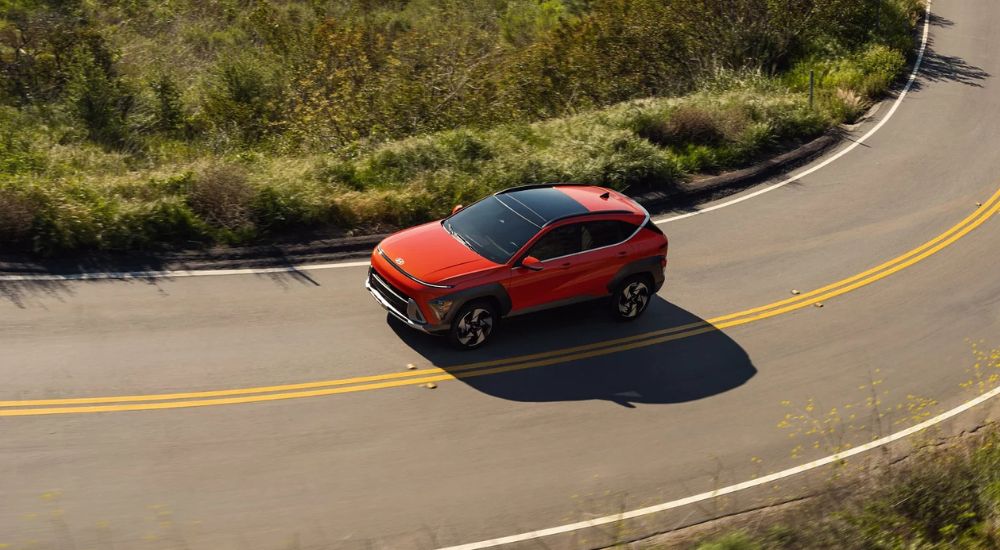
Affordability, fun, and utility are all on the table when you choose the 2026 Hyundai Kona. From the daily commute to weekend adventures and everything in between, the Kona can do it all. The crossover’s available AWD system is perfect for exploring off-the-grid locales, and a full suite of modern tech features will provide plenty of entertainment, support, and convenience when you hit the open road.
The HR-V isn’t a bad choice by any means, but it simply can’t match the high bar set by Hyundai’s subcompact SUV. Honda’s one-size-fits-all approach probably makes the shopping experience a little easier, but the lack of customization potential could leave drivers feeling like they’re piloting a cookie-cutter SUV around Grayslake when they spot the Kona in their rear-view mirror. With only three trims, one engine option, and an undersized infotainment display, the HR-V’s nondescript design won’t exactly get your blood pumping. When you need a daily drive that’s fun, stylish, and easy to street through tight city streets and crowded parking lots, the conversation begins and ends with the Hyundai Kona.
Connect with us


- June 2026
- May 2026
- April 2026
- March 2026
- February 2026
- January 2026
- December 2025
- November 2025
- October 2025
- August 2025
- July 2025
- June 2025
- May 2025
- April 2025
- March 2025
- February 2025
- November 2024
- May 2024
- April 2024
- March 2024
- February 2024
- January 2024
- December 2023
- November 2023
- October 2023
- June 2023
- February 2023
- January 2023
- December 2022
- November 2022
- October 2022
- September 2022
- August 2022
- July 2022
- June 2022
- May 2022
- April 2022
- February 2022
Archives
- Electric Vehicles for Sale
- Hyundai Dealer Near Kenosha
- Hyundai Dealer Near Libertyville
- Hyundai Dealer Near Mundelein
- Hyundai Dealer Near Pleasant Prairie
- Hyundai Elantra for Sale Near Libertyville
- Hyundai Elantra for Sale Near Waukegan
- Hyundai IONIQ 5 for Sale
- Hyundai Kona for Sale Near Grayslake
- Hyundai Palisade for Sale Near Libertyville
- Hyundai Santa Fe For Sale Near Round Lake Beach
- Hyundai Tucson for Sale
- Hyundai Tucson for Sale Near Elgin
- Hyundai Tucson for Sale Near Libertyville
- Uncategorized
- Used Cars for Sale
Categories
Gurnee Hyundai
Address
6251 Grand Ave.
Gurnee, IL 60031
Phone
- Sales 847-693-7089
- Service 224-637-1674
- Parts 224-637-1691
| Monday | 9:00AM - 8:00PM |
| Tuesday | 9:00AM - 8:00PM |
| Wednesday | 9:00AM - 8:00PM |
| Thursday | 9:00AM - 8:00PM |
| Friday | 9:00AM - 8:00PM |
| Saturday | 9:00AM - 6:00PM |
| Sunday | Closed |
| Monday | 7:00AM - 7:00PM |
| Tuesday | 7:00AM - 7:00PM |
| Wednesday | 7:00AM - 7:00PM |
| Thursday | 7:00AM - 7:00PM |
| Friday | 7:00AM - 7:00PM |
| Saturday | 8:00AM - 5:00PM |
| Sunday | Closed |
| Monday | 7:00AM - 6:00PM |
| Tuesday | 7:00AM - 6:00PM |
| Wednesday | 7:00AM - 6:00PM |
| Thursday | 7:00AM - 6:00PM |
| Friday | 7:00AM - 5:00PM |
| Saturday | 8:00AM - 5:00PM |
| Sunday | Closed |
