


Even in today’s competitive market, few models can match the Hyundai Tucson’s sheer versatility. The stylish, compact crossover checks all the boxes when it comes to the qualities drivers value most, offering the most cargo space in its class along with a long list of standard comfort, safety, and infotainment features. But the SUV has another trick up its sleeve, and it’s led plenty of drivers to seek out their own Hyundai Tucson for sale near Elgin. The crossover is available with three different powertrains, allowing drivers to dial in the perfect ride with gas, hybrid, and PHEV options.
Each model occupies its own specific niche, with some prioritizing performance while others put a premium on efficiency and cargo space. This flexibility has seen the Tucson rise through the sales charts with Hyundai moving nearly 250,000 units in 2025 alone. Let’s walk through each model and see which Tucson is right for you.
Performance
Hybrid technology has come a long way since the first production model rolled off of the assembly line back in the early 2000s. While initially focused on fuel economy, today’s hybrid models have become just as powerful as their gas-powered ancestors and, in many cases, even more so. Many of the market’s fastest models leverage hybrid tech, as well as the purpose-built racing machines you’ll find rounding your favorite Formula 1 circuit.
The Tucson is no exception, with two hybrid models allowing drivers to unlock a thrilling automotive experience. We’ll start with the star of the show in the Tucson PHEV. The plug-in hybrid easily tops the power rankings with 268 hp, though it matches its hybrid sibling in the torque department at 271 lb-ft. That’s a compelling figure for a compact model, and one that allows the PHEV to sprint from zero to 60 mph in as little as 7.1 seconds compared to 8.5 seconds for the non-hybrid.
The Tucson Hybrid posts a very similar acceleration figure to the PHEV. It can easily best segment rivals like Toyota’s RAV4 Hybrid to 60 mph in 7.3 seconds. The hybrid is rated for 231 hp which, while no match for the PHEV, is still almost a 25% power increase over the purely gas-powered version.
Opting for internal-combustion sees the Tucson produce 187 hp and 178 lb-ft of torque. While this might not do much for the crossover’s performance resume, it does make a difference when it comes time to tow. The gas-powered Tucson can pull as much as 2,750 lbs, while the hybrids are limited to 2,000 lb. Still, if you’re in the market for an engaging, responsive ride that’ll add a little excitement to your daily commute, the Tucson hybrid and PHEV make a pretty strong case for themselves.
Efficiency
With both traditional hybrid and PHEV powertrains on the table, it’s easy to save a little money at the pump when you choose the 2026 Hyundai Tucson. Even the gas-powered model trends right around the segment average, with an EPA-estimated 28 MPG combined, but a little electrification goes a long way toward lowering your lifetime operating costs. Then there are the hybrids. One might think that the PHEV would have a clear advantage over the hybrid, but both actually trend pretty close to one another in terms of efficiency.
How is an eco-conscious Elgin driver supposed to choose between the two models? It all comes down to how the SUV is going to be used. If your time behind the wheel tends to involve a lot of extended road trips and long commutes, the hybrid’s flexibility is pretty tough to ignore. The crossover’s 1.6L turbocharged I-4 achieves a nice, even 38 MPG in both city and highway conditions. Unlike today’s all-electric models, it never requires an extended pit stop to top off the battery. Best of all, the hybrid comes standard with a six-speed automatic transmission and all-wheel drive, so you’ll never need to worry about traction when you’re behind the wheel.
The Tucson PHEV trends a bit lower at 35 MPG, but that doesn’t tell the whole story. By equipping the plug-in model with a larger, 13.8-kWh battery, Hyundai provides drivers with up to 32 miles of all-electric driving range. This makes the PHEV particularly well-suited to urban environments, and means that drivers could theoretically bypass the gas pump altogether with a little advanced planning. The PHEV can be fully recharged in two hours using a Level 2 charging station. It also offers an impressive range when you tap both the battery and gas tank, with a tested range of around 380 miles. If efficiency is at the top of your must-have features list for a new SUV, the Tucson hybrid and PHEV are worth a closer look.
Space
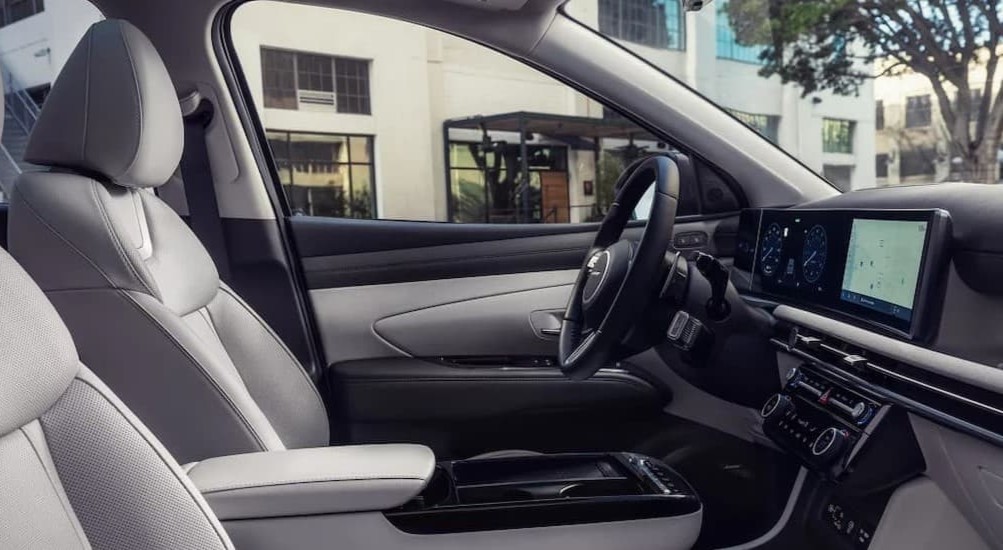
The Tucson leads the segment in maximum cargo space, defying its compact designation to provide drivers with a roomy ride that offers plenty of space for passengers and storage. That said, the Tucson’s three iterations aren’t exactly created equal. The gas model and the standard hybrid offer the most spacious options, while the PHEV sacrifices a little space to accommodate its larger 13.8-kWh battery. While the first two models deliver more than 80 cu.ft. of cargo room, the PHEV measures in at around 71.8 cu.ft. The story is largely the same when both rows are in use, with the gas and hybrid offering 41.2 cu.ft to the PHEV’s 31.9 cu.ft. Second-row passengers will enjoy more legroom with either of the first two options, but the PHEV’s back seat could feel a little cozy for adults on extended road trips outside Elgin.
Sheer space isn’t the only difference between the Tucson models. The hybrid and PHEV versions have higher starting prices than their gas-powered counterparts. While some of the cost can be tied to battery costs and the relative complexity of the hybrid approach, the electrically-assisted Tucsons are simply better equipped. The standard AWD setup is certainly nice, but the Tucson Hybrid and PHEV are also both packed with a generous array of standard comfort, convenience, and safety tech that you won’t find on the entry-level gas trim. These features include heated side mirrors, a 12.3-inch digital instrument panel display, steering wheel-mounted paddle shifters, and a hands-free power liftgate.
Tucson by Way of Gurnee Hyundai
There’s no wrong answer when picking between the Tucson’s three available powertrains. A wide range of engines lets the SUV serve a broad range of Elgin drivers, so buyers can prioritize performance, price, and efficiency as they see fit. That said, the standard hybrid probably represents the most versatile model, and might just be the best value of the bunch. It might not offer the PHEV’s all-electric driving range, and can’t tow as much as the gas-powered version, but its well-rounded design and competitive price make the hybrid pretty tough to pass up. You also won’t need to worry about charging times or range-related issues as the temperature starts to drop.
If you’re still having a tough time picking your perfect Tucson, Gurnee Hyundai is here to help. We’re ready to answer any questions you might have, share our personal experience, and do everything in our power to ensure you drive off the lot in a new SUV that keeps putting a smile on your face for years to come.
Connect with us


- June 2026
- May 2026
- April 2026
- March 2026
- February 2026
- January 2026
- December 2025
- November 2025
- October 2025
- August 2025
- July 2025
- June 2025
- May 2025
- April 2025
- March 2025
- February 2025
- November 2024
- May 2024
- April 2024
- March 2024
- February 2024
- January 2024
- December 2023
- November 2023
- October 2023
- June 2023
- February 2023
- January 2023
- December 2022
- November 2022
- October 2022
- September 2022
- August 2022
- July 2022
- June 2022
- May 2022
- April 2022
- February 2022
Archives
- Electric Vehicles for Sale
- Hyundai Dealer Near Kenosha
- Hyundai Dealer Near Libertyville
- Hyundai Dealer Near Mundelein
- Hyundai Dealer Near Pleasant Prairie
- Hyundai Elantra for Sale Near Libertyville
- Hyundai Elantra for Sale Near Waukegan
- Hyundai IONIQ 5 for Sale
- Hyundai Kona for Sale Near Grayslake
- Hyundai Palisade for Sale Near Libertyville
- Hyundai Santa Fe For Sale Near Round Lake Beach
- Hyundai Tucson for Sale
- Hyundai Tucson for Sale Near Elgin
- Hyundai Tucson for Sale Near Libertyville
- Uncategorized
- Used Cars for Sale
Categories
Gurnee Hyundai

Address
6251 Grand Ave.
Gurnee, IL 60031
Phone
- Sales 847-693-7089
- Service 224-637-1674
- Parts 224-637-1691
| Monday | 9:00AM - 8:00PM |
| Tuesday | 9:00AM - 8:00PM |
| Wednesday | 9:00AM - 8:00PM |
| Thursday | 9:00AM - 8:00PM |
| Friday | 9:00AM - 8:00PM |
| Saturday | 9:00AM - 6:00PM |
| Sunday | Closed |
| Monday | 7:00AM - 7:00PM |
| Tuesday | 7:00AM - 7:00PM |
| Wednesday | 7:00AM - 7:00PM |
| Thursday | 7:00AM - 7:00PM |
| Friday | 7:00AM - 7:00PM |
| Saturday | 8:00AM - 5:00PM |
| Sunday | Closed |
| Monday | 7:00AM - 6:00PM |
| Tuesday | 7:00AM - 6:00PM |
| Wednesday | 7:00AM - 6:00PM |
| Thursday | 7:00AM - 6:00PM |
| Friday | 7:00AM - 5:00PM |
| Saturday | 8:00AM - 5:00PM |
| Sunday | Closed |
